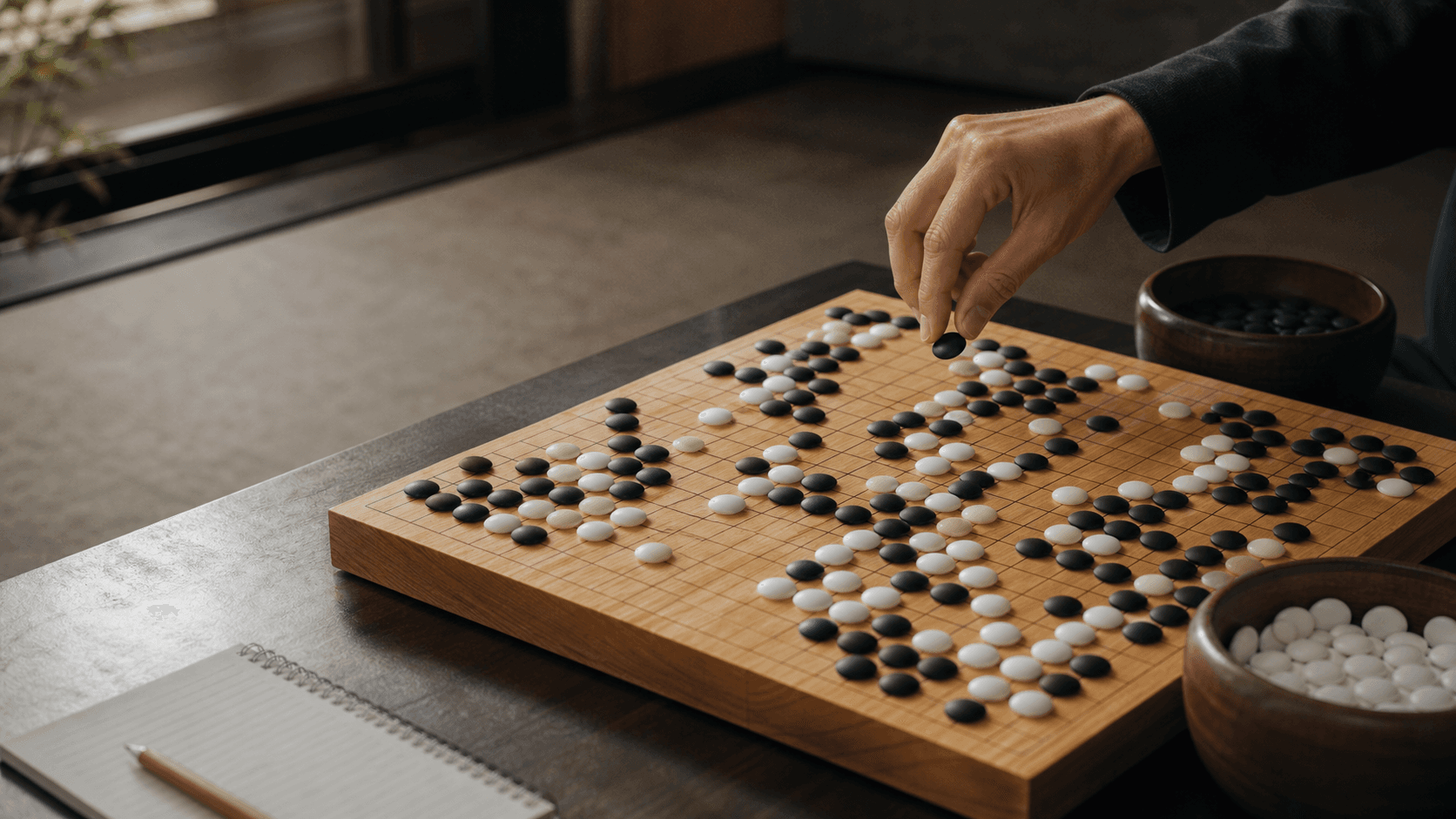
The connection between Go and strategic command is more than two thousand years old.
Writing in the 1st century AD, the Han dynasty scholar Huan Tan described weiqi, the Chinese name for Go, as "." Around 1050 AD, the classical Go manual was structured in thirteen chapters, deliberately mirroring Sun Tzu's Art of War. Cao Cao, the dominant military commander of the Three Kingdoms period, was a documented weiqi player. In Tokugawa Japan, Go became institutional. The shogunate funded hereditary Go academies, appointed an official Minister of Go, and had the nation's strongest players compete annually before the shogun.
The association endured into the modern era. Henry Kissinger interpreted Chinese strategic culture through Go. Military analysts used it to explain China's geopolitical behaviour. Business books translated Go into lessons on leadership and competitive strategy.
For two thousand years, the tradition has remained remarkably consistent.
Yet somewhere along the way, something subtle changed.
We stopped treating Go as a simulation and began treating it as a metaphor.
And failure followed every time.
Where the metaphor always fails
Go has been borrowed as for decades. The failure mode comes in two forms, and both are recognisable.
When prediction replaced observation
Henry Kissinger articulated the frame in 2011: "It's a game of strategic encirclement. Our intellectual game is chess." used it to predict indirect pressure and long-game patience. At the US Army's 2019 AI symposium, Shield AI's COO applied the same logic: "The Chinese are playing Go, which is about surrounding, taking more territory and surrounding your adversary." The was the same in both cases: patient accumulation, encirclement before confrontation. What arrived instead was directness: territorial seizure, chip export controls, explicit decoupling.
When the advice outlived the game
Troy Anderson's The Way of Go (Free Press, 2004) translates eight Go concepts into business strategy: knowing when to seize initiative, cutting losses on failing positions, using indirection over direct attack. and every principle survives intact. The game supplies the authority; the advice supplies the content; neither required the other.
A good metaphor points in a productive direction. Pointing is not the same as being inside it.
A good metaphor points in a productive direction. Pointing is not the same as being inside it.
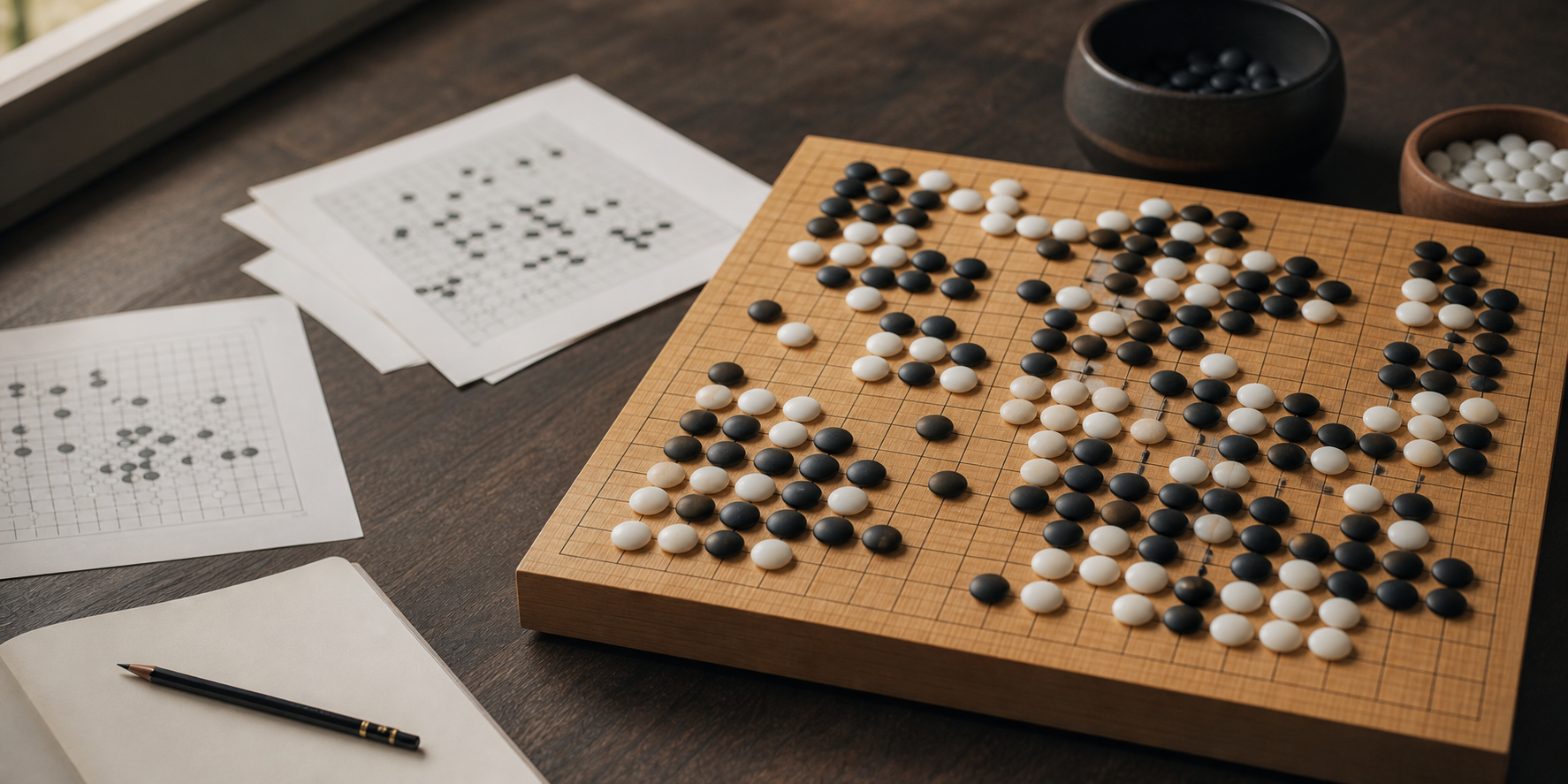
A practice environment, not a metaphor
Go is , a structure where the conditions of real strategic work are created rather than described.
No flight simulator replaced aeronautical theory, but no airline puts an untrained pilot in the air on theory alone. Nor is the purpose of a flight simulator to teach aerodynamics. It exists to reveal how a pilot behaves when knowledge meets consequence: the cost of error, decisions that cannot be deferred. What it reveals is not knowledge but behaviour.
A metaphor gives you a concept to carry. A practice environment puts you inside the conditions themselves. What becomes visible is not your intended behaviour or the version you would describe in a debrief. It is what you actually do when the stakes are real and the situation will not wait.
A metaphor gives you a concept to carry. A practice environment puts you inside the conditions themselves.
Why not chess?
Chess is an extraordinary game: no randomness, full information, genuine depth. What it does not offer: distributed criticality, a genuine evaluation problem, or meaningful feedback delay. Those are precisely the properties where real strategic command diverges from chess, and they are three of the six that follow.
The conditions no other game creates
The six properties below each appear in other environments in isolation. Delayed feedback exists in markets. Path dependency exists in any sequential decision system. The evaluation problem exists in negotiation. What no other game produces is all six simultaneously, within a contained and repeatable structure.
Simple rules, emergent complexity
Go has one stone type and five rules. None of the vocabulary that organises actual play appears in those rules: not life and death, not territory, not influence, not thickness. These are , created by the game, not specified by its design.
Distributed criticality
In Go, no move announces itself as the decisive one. Weight is distributed across the whole board and the whole game. No single stone carries obvious . The stone that determined the outcome was rarely recognisable as such when it was played.
Delayed feedback
You cannot know in the opening whether you played well until the middle game develops. The consequences of a move arrive late. Go does not try to shorten this. is a feature of the environment, not a flaw in the design.
Path dependency
Every stone placed stays placed. The board only accumulates. A mediocre move early weakens a group, forces defensive responses elsewhere, and constrains your options deep into the endgame. The error in ways that were not visible when the choice was made.
The evaluation problem
In Go, position cannot be reduced to a score. One player may hold secure territory in the corners while the other controls influence across the board. Neither converts into a common currency without judgment. These advantages have no common measure. Working out their relative value is the , and it was intractable enough to keep computers at amateur level until 2016.
No randomness
There is no randomness in Go. No dice, no hidden cards. The board is fully visible to both players. All the is structural: it comes from complexity and the impossibility of reading your opponent's intention.
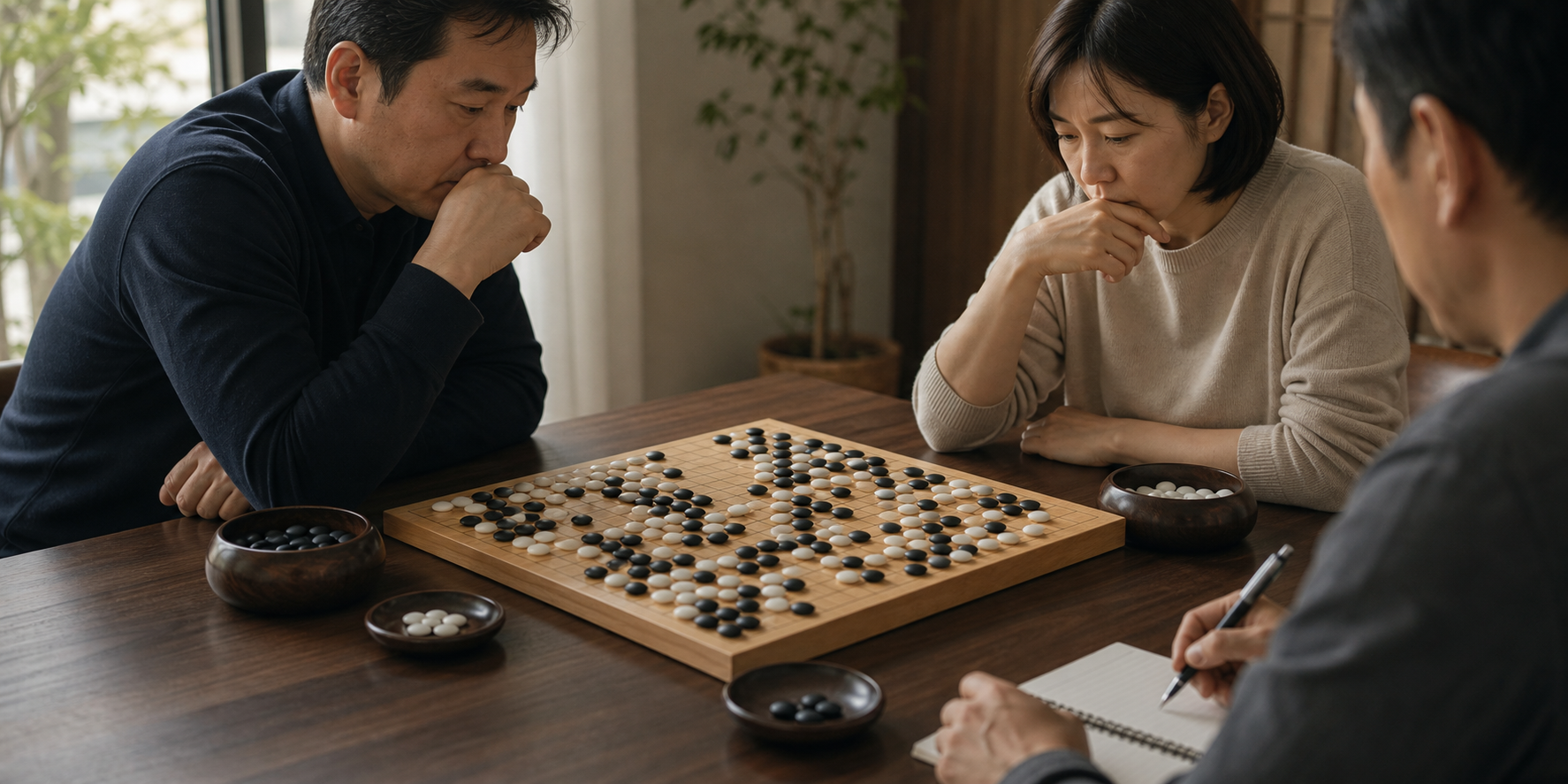
What becomes visible
What becomes visible in a Go game is not how someone plays Go. It is how they make decisions under the conditions the game creates: whether they commit too early, whether they read the local situation and miss the global one, whether they adapt when conditions shift or double down on a failing position, whether they recognise when the problem itself has changed. These are , patterns that surface under real cognitive load, made legible by the structure of the game.
The six properties do not operate independently. Under their combination, strategic behaviour is not described or discussed. It is produced, recorded, and available for inspection.
The tradition did not endure because people extracted wisdom from Go. It endured because they played.
The tradition did not endure because people extracted wisdom from Go. It endured because they played. That is why Go. Not because the game is ancient or elegant. Because it is the only environment that creates all of these conditions simultaneously, and because few environments expose strategic judgment as clearly.