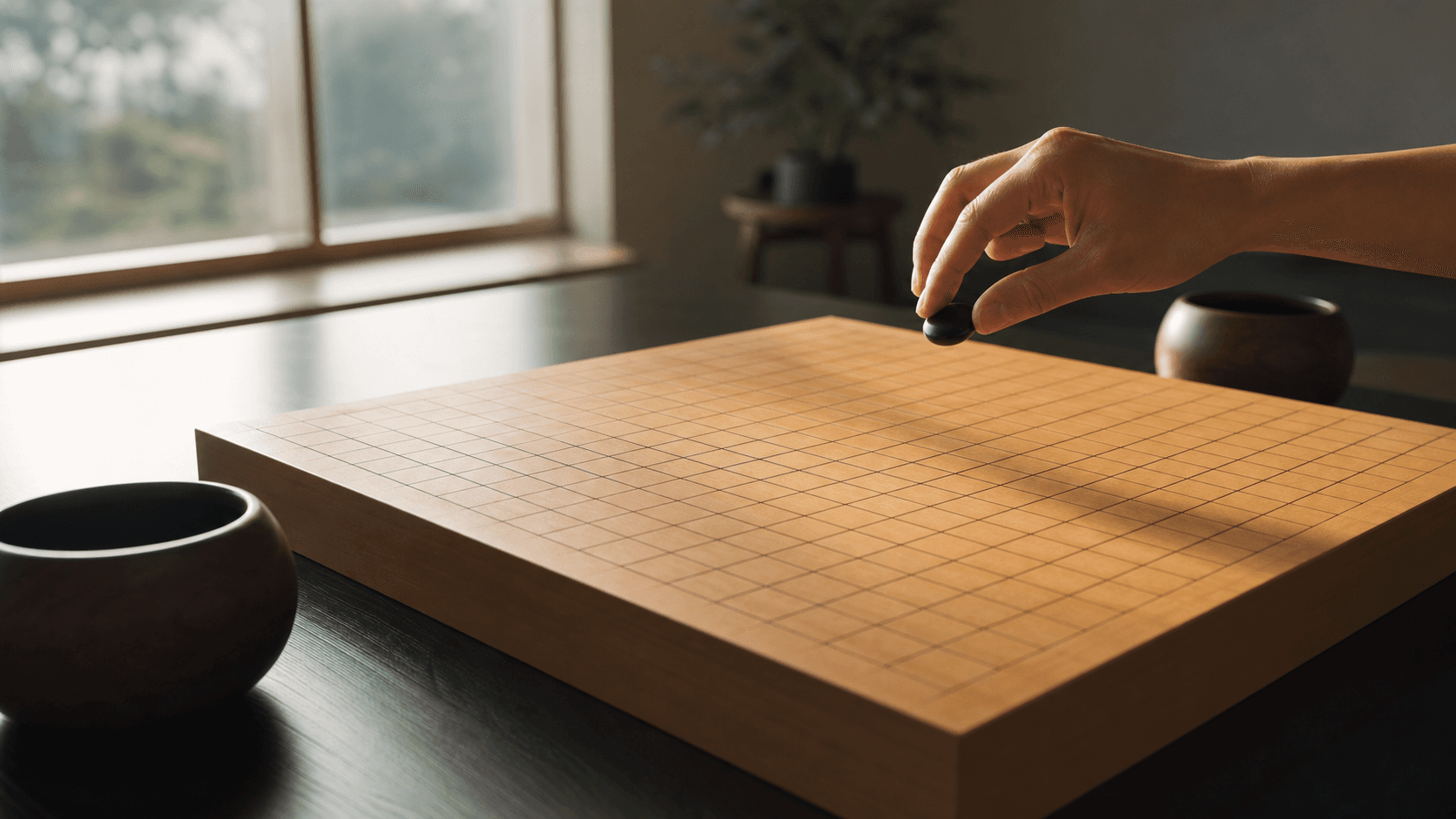
The board is empty. You have twenty minutes of Go instruction behind you. You pick up a stone.
"It's the first move. It's all the same. As good as random. Let me just play somewhere."
Before you place it, I offer to take it from you: to drop it anywhere on the board from above and let it land wherever it falls. Random, as you described it.
Almost nobody lets me.
"I'll make my own random move, thank you." The grab that follows is fast. Sometimes aggressive. The body moves before the mind has a chance to maintain its position.
That refusal is the most diagnostic thing in the room. Not the move itself. The refusal.
Not random
Calling the move random is protective. You've had twenty minutes of instruction in an unfamiliar game, in an unfamiliar room, with people you may not know well. Claiming randomness removes the exposure. If the move is random, it cannot be wrong.
But the body has already disagreed. There was a preference, a pull toward a position, an instinct about where to place the stone. That is not nothing. It is reasoning that hasn't given itself permission to call itself reasoning.
How hard they pull back on the stone is usually a preview of what follows. A tentative retrieve means the reasoning is there but faint, still uncertain of its own standing. A hard grab means it's already running. The same energy goes into the thinking once they understand it's valid in this room.
Your instinct is data.
The most common thing said after the grab: your instinct is data. You don't need to know Go to have a view on the board. You just need to look at it. That permission, once given, rarely needs to be given again.
Four moves, then nothing
Some participants arrive having done advance reading: a quick search on Go openings, a video or two, enough to feel ready. They've come to get an edge. Corner, they know, is where you start. They play there immediately, with a certainty the rest of the room doesn't yet share.
Ask why. The answer trails off mid-sentence, or arrives as repetition: "It's... the corner is where you start. It's the best opening." They have the conclusion. They don't have what generated it.
The game proceeds cleanly for four moves. The corners get claimed. Then: what? The script has exactly that many lines. Move five is the first genuine strategic decision, the position the preparation didn't cover. Before they play, their eyes move around the room: checking other boards, reading what others have done. The reference point has shifted from the research they arrived with to the room itself. The underlying relationship to reasoning has not.
They don't go quiet. They pivot. They become evaluators: watching others' moves, noting deviations from theory, suggesting what should have been played. When the preparation runs dry, they borrow from the room instead.
The reasoning that holds
The third pattern is the easiest to miss early. These players take their time on the first move. They look at the board, actually look at it, and place a stone that may not align with theory. Corner might not be where they go.
Ask why, and they can say. The reasoning may be incomplete, occasionally wrong about Go, but it belongs to them. It came from reading the position rather than consulting a reference.
What becomes visible over the course of the game is a quality that has nothing to do with Go knowledge: comfort with setbacks. When a group comes under pressure, or a stone is captured, they don't reach for a new theory. They read the new position from the same base they started with. The reasoning adapts because there was reasoning to begin with.
By the midgame, these players often have the most coherent board presence in the room. Not the best position. The most consistent internal logic. There is a calm that comes from having a process, even an imperfect one: you know how you're thinking, so you know where to look when things go wrong.
What the board is actually measuring
Three patterns. The board cannot distinguish them in the opening. By move five, they are unmistakable.
They are not fixed types. The same person can move between them as the game develops, or occupy different positions in different domains.
The first move is not a test of Go knowledge. None of these players has much of that. What it measures is something that is hard to see in most other contexts: what a person does when the known answers run out.
The hidden reasoner had reasoning all along. They needed permission to access it, not instruction. The borrowed-conclusion player had an answer without the reasoning that generated it: when conditions changed, they went looking for someone else's. The coherent player had a process rather than a script, and the process held.
The corner gets claimed. The script runs out. What remains is whatever was underneath it.
In strategy, the script always runs out. Every strategist eventually reaches move five: the position the preparation didn't cover, the question the framework didn't anticipate. What fails at that moment isn't knowledge. It's the ability to keep generating structure once the memorised answers run out. The board surfaces it in twenty minutes. An hour of structured interview does not.