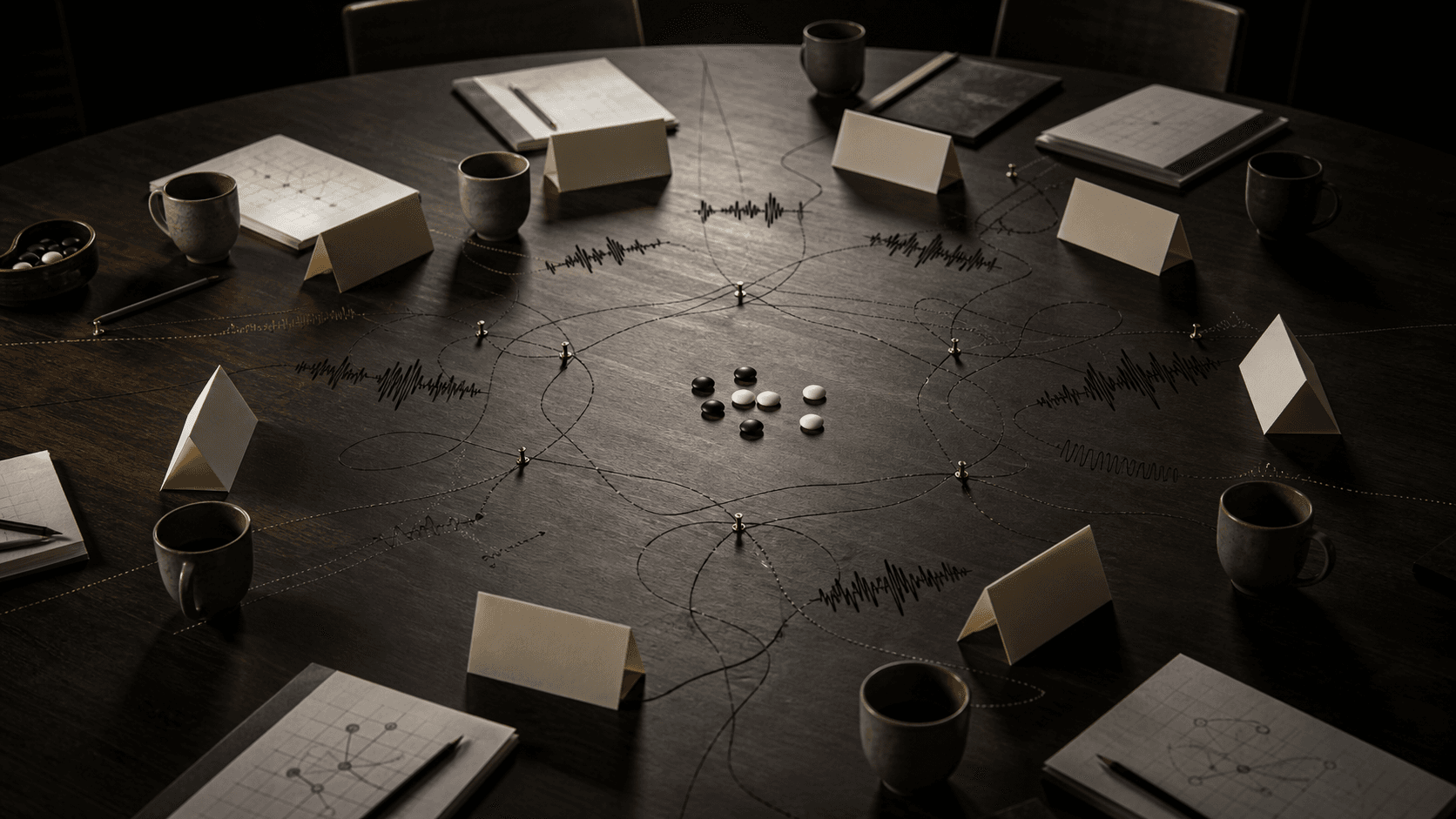
I remember the first time I noticed it clearly.
Four participants were gathered around the board trying to decide whether to connect two groups in the centre. The move itself wasn't especially difficult. At least, not difficult enough to justify the amount of conversation it was generating.
Someone suggested connecting.
Another pointed out a weakness elsewhere.
A third proposed playing on the side instead.
Everyone nodded. Nobody disagreed. Nobody played.
After another minute someone said, "We have a few good options."
Everyone agreed.
Still nobody played.
Nothing was rejected. Nothing was accepted. The idea simply stopped existing.
Standing beside the board, I found myself thinking something I hadn't consciously thought before.
They're not going to decide.
Not because the position was difficult. Because I could hear the decision slowly disappearing from the conversation.
That question stayed with me: why did I know?
Not indecision
The conversation hadn't stopped. Everyone was contributing. Nobody was stuck. From the outside it still looked collaborative — options surfacing, alternatives considered, no one dominating.
But listen more carefully to what was being said.
"What do you guys think?"
"Either works."
"I'm okay with whatever."
"Let's hear everyone's thoughts first."
None of those sentences are indecisive. Each sounds considered, even generous. Collectively they do something more specific than indecision.
They remove ownership from the conversation.
The difference matters. A team that can't decide is searching for an answer. A team where nobody owns the next move has stopped searching without knowing it. The conversation keeps running. The decision has already left.
Converging vs circulating
There are two things a strategic conversation can do.
It can converge: taking available positions and moving them toward commitment. Each exchange narrows the space. Disagreement does useful work. Someone says what they actually think and holds it long enough for others to engage with it.
Or it can circulate: generating energy without converting it. Options appear and recede. Alternatives surface without displacing anything. Nobody is wrong, because nobody has committed to being right.
You can hear the difference.
Converging conversations have friction. Someone says "I think we should play here" and another says "I don't think that solves the real problem." The disagreement is in the room now. It has somewhere to go.
Circulating conversations have none. The phrases are smooth. The nodding is continuous. Everyone feels heard because nothing has been challenged.
The orphaned decision
Occasionally a moment makes this visible.
Someone says, "I still don't think this is the right move."
The room pauses. Then another person says, "Okay... but what should we play?"
If the first person has an answer, the conversation deepens. If they don't, something else happens. The objection quietly dissolves. Not because it was wrong. Because it was orphaned: it had no path forward.
This is what I've come to call an orphaned decision. Not a decision made badly. A decision never really adopted by anyone. An idea that before everyone assumed someone else would carry it forward.
Agreement doesn't mean alignment. Sometimes it means the team has quietly decided that is more important than resolving uncertainty.
The board eventually exposes the difference. Teams that keep disagreement alive reach better decisions because the disagreement keeps doing useful work. Teams that smooth it away too early find the uncertainty didn't disappear. It followed them into execution.
Before it appears on the board
The board isn't revealing strategy. The conversation is.
I've sat beside enough boards to recognise the sound now before the evidence appears on the board itself.
The phrases are the tell. Not because any one of them is wrong. Because when they dominate the conversation, they signal what the conversation is actually for.
Most failed decisions don't fail because nobody had a good idea.
They fail because ownership quietly evaporated while everyone believed the conversation was still moving.
The board notices. The facilitator notices. The team usually notices much later.