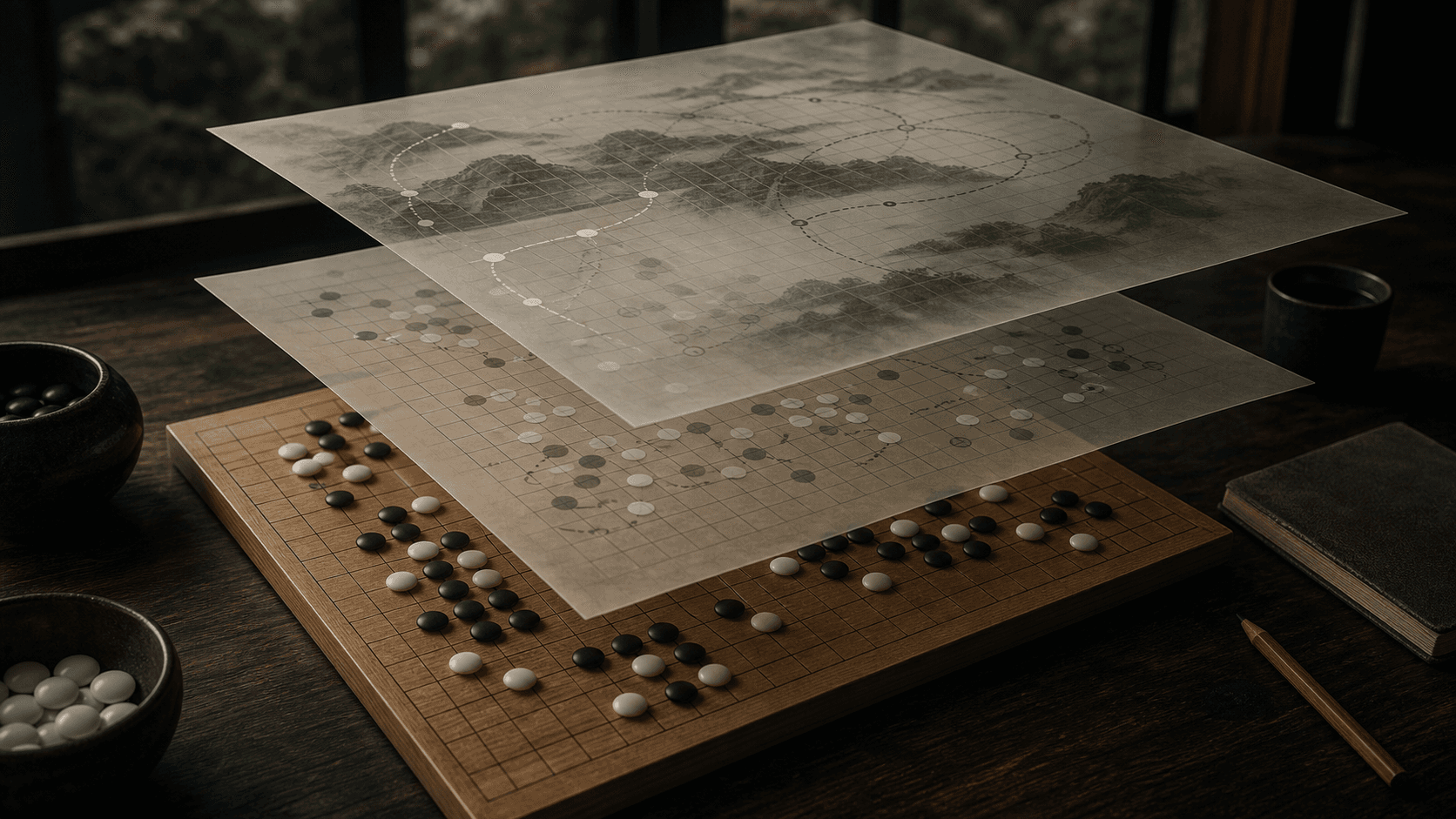
We had scheduled one game.
He worked in finance. The kind of work where you build the model before you make the commitment, where the analysis is supposed to precede the view. He sat down, looked at the empty board for a moment, and picked up his first stone.
Game one was all present tense. Each move answered the last. When one area came under pressure, that became the entire game. When another opportunity appeared elsewhere, his attention shifted with it. There was a position by the midgame, but there wasn't yet a direction. Every decision made sense on its own, but they hadn't begun to form a coherent whole.
After the game, before I asked anything, he spoke.
"If I could play that again, I think I'd approach it very differently."
"What would you change?"
"I don't think I'd rush into solving every problem as it appeared. I'd probably spend more time understanding what kind of position I was trying to create first. There were moments where I became so focused on what was happening in one part of the board that I stopped paying attention to everything else."
He paused.
"I think I was playing locally when I should have been thinking globally."
I think I was playing locally when I should have been thinking globally.
That sentence had almost nothing to do with Go.
We played again.
Then a third time.
We had scheduled one.
Familiar enough to strategize
By the third game, the texture had changed.
He still made mistakes. The difference was that the mistakes now belonged to a plan. Before placing a stone he would pause, not because he was unsure, but because he was weighing possibilities. Sometimes he would talk through them aloud.
"I'm trying not to commit too early."
"If I play here, I don't want it to close off my options later."
"I think this move creates more possibilities than it solves problems."
"There are a few things happening at once. I don't think the biggest problem on the board is necessarily the most important one."
The board itself hadn't become simpler. If anything, it had become more complicated. There were more stones, more interactions, more consequences to consider. Yet his thinking had become calmer. He had stopped reacting to individual moments and started thinking about how those moments related to the whole.
At the end I asked him whether he had noticed the change.
"Yeah," he said. "Now that I'm a little more familiar with the game, I can strategize a lot easier."
It was a perfectly reasonable explanation. Across three games he had become noticeably more strategic, and familiarity had increased alongside it. It was natural to conclude that one had produced the other.
But I wasn't convinced that was what had happened.
"How much of what you just described actually required knowledge of Go?"
He looked back at the board for a while before answering.
"Actually... not much."
Then he laughed.
The toolkit was already in the room
Listen carefully to the way he had been describing his thinking.
He wasn't talking about corners or influence, ladders or life and death. He was talking about preserving options, resisting premature commitment, balancing local decisions against a global position, thinking in contingencies, and shaping future possibilities instead of simply reacting to the present.
None of those belong to Go.
They are strategic concepts. They are just as relevant in finance, leadership, negotiations, product design, or public policy as they are on a nineteen-by-nineteen board.
He had not learned those ideas over the course of three games. He had spent years developing them. The board had simply given him a place where those habits of thought became visible. Finance hadn't disappeared when he sat down to play Go. It had arrived disguised as something else.
Finance dressed in a Go costume.
So what had changed?
Not his capacity to think strategically.
Not even very much Go knowledge.
The board had stopped feeling foreign. Somewhere between the first game and the third, he had crossed an invisible threshold. The game no longer felt like a strange collection of unfamiliar rules. It had become a strategic environment, and once that happened, he instinctively began engaging it with capabilities he already possessed.
Permission, not knowledge
Most of us tell the same story he did.
Strategic thinking comes after familiarity.
Learn enough first. Understand the domain. Build enough experience. Then you'll be ready to form a view.
It feels true because familiarity and better thinking often appear together. But perhaps we mistake correlation for cause.
Very little of what made his third game more strategic depended on Go itself. It depended on recognising patterns, holding multiple futures in mind, balancing local and global considerations, preserving optionality, and deciding when commitment created value rather than constraint. Those are not Go skills. They are ways of thinking. The difference was that by the third game he finally believed the board was familiar enough to deserve them.
Perhaps what familiarity gives us is not strategic ability, but permission to use the strategic ability we already have.
Perhaps what familiarity gives us is not strategic ability, but permission to use the strategic ability we already have.
The first game problem
That hesitation is not unique to Go.
It appears every time we enter unfamiliar territory. A new leadership role. A different industry. The first months of a startup. A technology we've never used before. We tell ourselves we're still learning, as though strategic thinking is something that should wait until we know enough.
Sometimes that's true.
More often, we're postponing capabilities we already possess.
The Go board compresses that transition into ninety minutes. You can watch someone move from a first-game mindset to a third-game mindset in a single afternoon, then ask a question while the shift is still fresh.
If so little of your third-game thinking actually depended on Go, what is preventing you from bringing that same mindset to the first games you encounter everywhere else?
He didn't answer immediately.
Neither will most people.