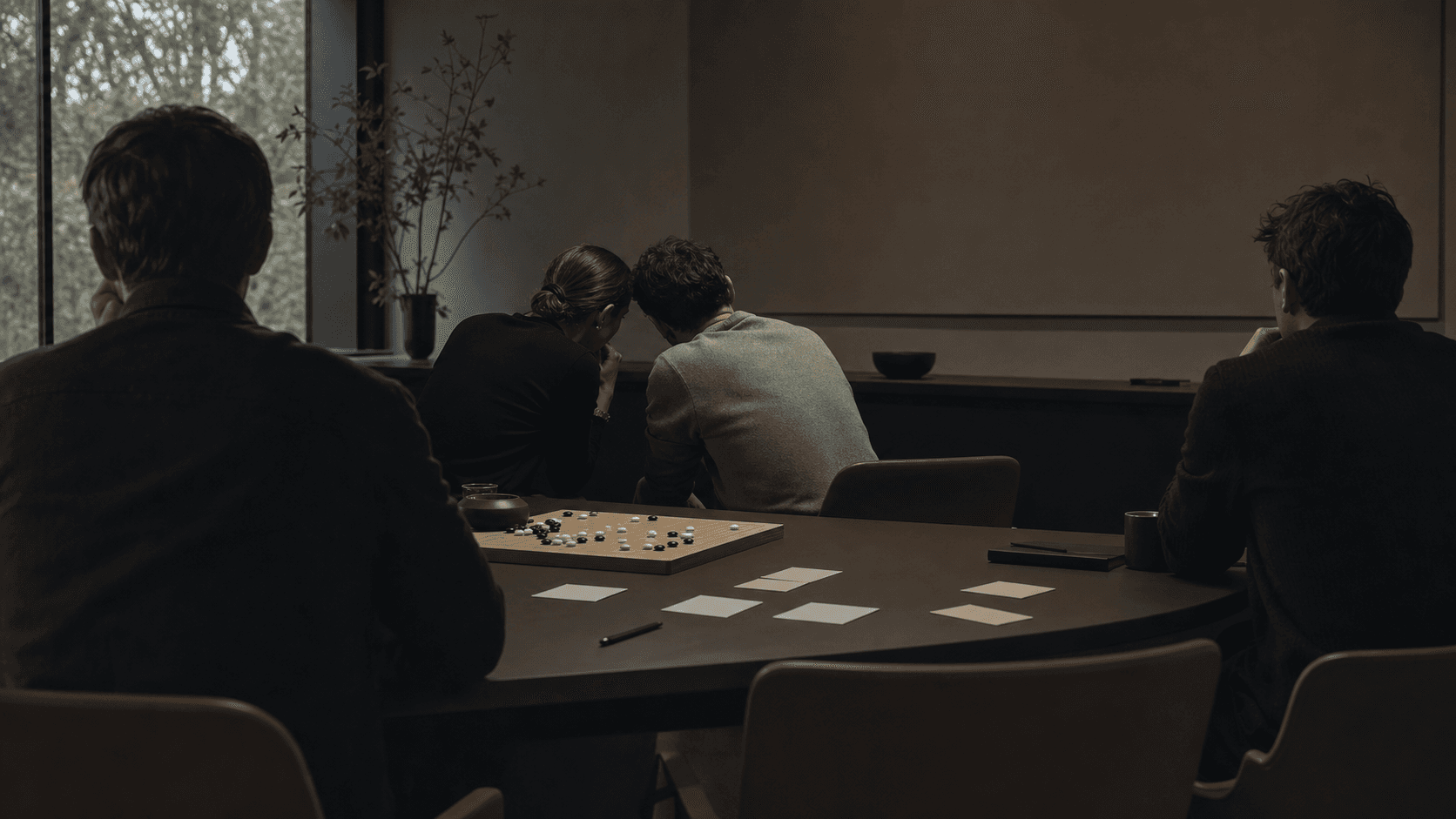
During one Strategic Mirror immersion, we divided participants into two teams and asked them to play against each other.
The teams approached the game very differently.
One team talked.
Someone placed a stone and explained why. Someone else disagreed. A third person built on the disagreement. Questions interrupted conclusions before they settled into certainty, and half-formed ideas were offered without much hesitation because everyone understood they were still being worked out. The conversation wasn't particularly orderly, but it had momentum. Their thinking seemed to happen in public.
The other team whispered.
Not because they had less to say. The opposing team was standing only a few feet away, and whatever they were planning felt like something that should remain inside the huddle.
At first, the difference seemed trivial. Both teams were discussing moves. Both were engaged. Both were trying to solve the same strategic problem.
Then the whispers began changing the way they thought.
Half-formed ideas stayed half-formed because nobody wanted to expose them before they were ready. Questions went unasked because asking them aloud felt like revealing uncertainty. The person who might normally have challenged an assumption became quieter, and the reasoning that needed disagreement to sharpen never quite found it.
Something else happened as well.
Every time the other team spoke, heads turned.
Conversations paused mid-sentence so people could listen. A move would be played, and before discussing their own response, someone would ask, "What do you think they mean by that?" Attention drifted back and forth between the board in front of them and the conversation happening a few feet away.
Without ever discussing it explicitly, they had begun playing two games at once.
The first was the game on the board.
The second was the game of information management: deciding what to reveal, what to conceal, and trying to extract clues from the other team's conversation.
The second game felt strategically important.
It just wasn't the game that mattered most.
The other team wasn't playing that second game at all. They had accepted that anything they said might be overheard, so almost all of their cognitive effort remained focused on one thing: . Every objection strengthened an idea. Every alternative exposed a weak assumption. Every explanation forced greater clarity before a stone was ever placed.
By the middle of the game, the difference became difficult to ignore. The louder team wasn't simply ahead. They were setting the agenda for both sides, creating strategic problems faster than the whispering team could resolve the previous ones. Increasingly, one team was generating strategy while the other was reacting to it.
It would be easy to conclude that the talking team simply communicated better.
I don't think that's what happened.
Attention, not information
Very little of what they were hiding was actually strategy.
Most of it was unfinished thinking.
Ideas that hadn't yet been tested. Questions that hadn't yet been asked. Connections that hadn't yet been challenged.
Those ideas weren't fragile because the other team might hear them. They were fragile because they hadn't yet survived disagreement.
Those ideas weren't fragile because the other team might hear them. They were fragile because they hadn't yet survived disagreement.
The whispering team believed they were protecting information. In reality, they were trading away attention.
Every moment spent wondering what the other team might have heard was a moment not spent improving their own reasoning. Every attempt to overhear the opposing discussion came at the cost of finishing their own. They weren't just protecting unfinished ideas. They were interrupting the process that would have made those ideas better.
The talking team understood something without ever saying it explicitly. An incomplete idea doesn't become stronger by staying private. It becomes stronger by surviving criticism. Every objection removes a weak assumption. Every alternative forces a clearer explanation. Every disagreement reveals whether an idea actually holds together.
The conversation was producing it
Many organisations quietly assume that communication comes after thinking.
First we analyse. Then we decide. Then we communicate.
But some of the strongest strategic thinking doesn't happen before communication. It happens because of it.
People often discover what they think only when they . Assumptions that felt obvious become questionable the moment someone asks, "Why?" Weak reasoning rarely survives open discussion, while stronger reasoning almost always benefits from it.
The conversation wasn't simply communicating strategy. It was producing it.
That doesn't mean every conversation should happen in public, or that confidentiality never matters. Some information genuinely needs protecting.
But organisations often protect far more than information.
They protect unfinished thinking.
They wait until ideas feel polished before exposing them to the very people most capable of improving them.
A game they chose
What stayed with me wasn't that one team whispered while the other spoke freely.
It was how quickly the whispering team accepted a second game that existed largely in their own minds.
The board never required them to divide their attention between improving their own strategy and managing information. They chose to. And once they did, a surprising amount of their cognitive energy stopped flowing into the game they had actually come to play.
The board revealed something I hadn't expected.
Sometimes the greatest threat to strategic thinking isn't the possibility that someone else might hear your ideas. It's the attention you stop giving to making those ideas worth hearing in the first place.