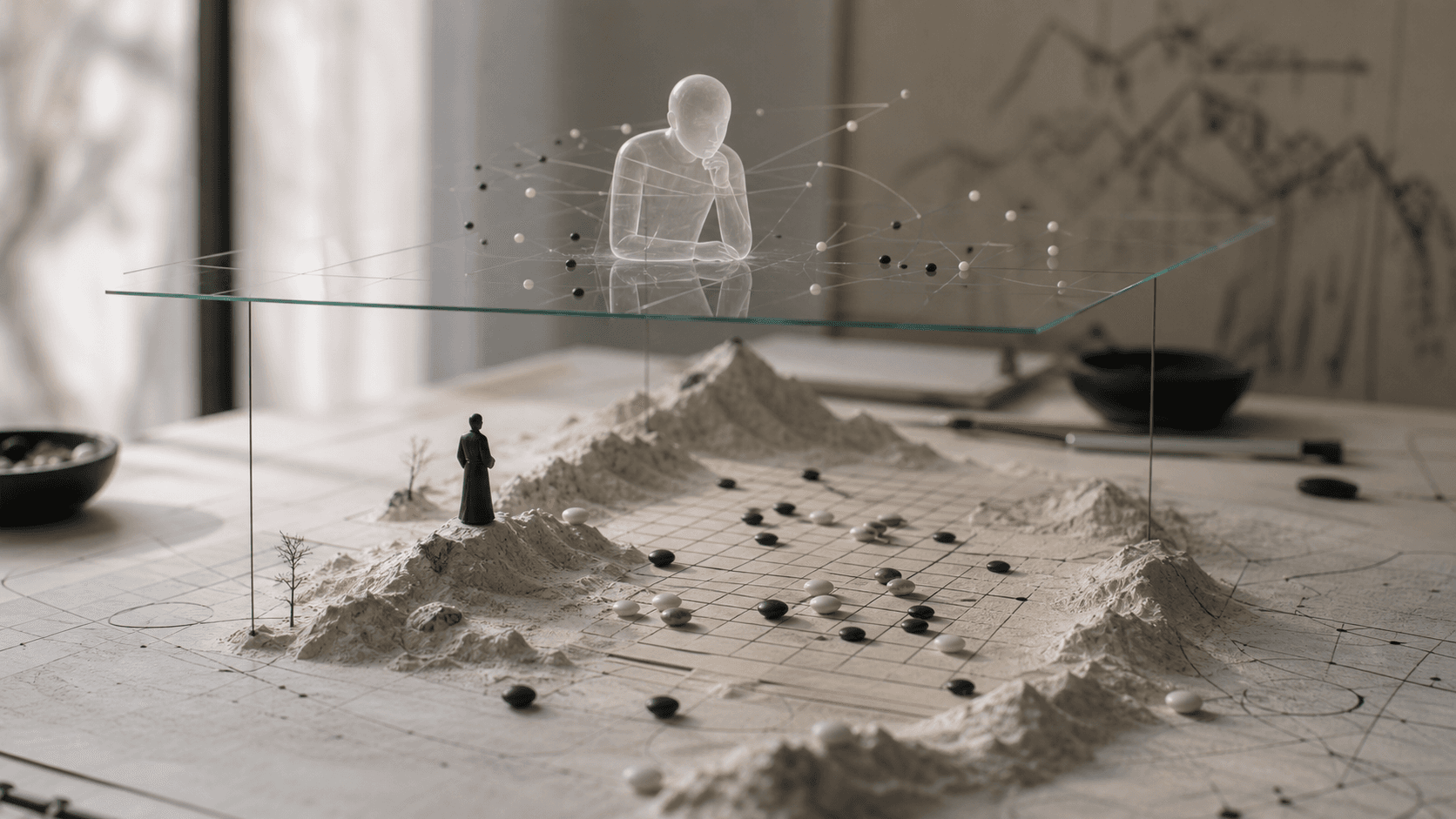
The phrase 'second-order thinking' has become common in leadership discourse. It tends to mean thinking about consequences, asking not just 'what happens if we do this' but 'what happens as a result of what happens if we do this.' This is a useful concept. It is not what FusekiB means by second-order strategic mindset.
In the FusekiB framework, the distinction is not between first and second-order consequences. It is between first and second-order awareness. A first-order thinker thinks. A second-order thinker thinks about how they are thinking, while they are thinking.
The observer position
The core capacity of the second-order strategic mindset is what we call the observer position, the ability to hold a dual awareness during high-stakes strategic work. The first awareness is the content of the situation: what is happening, what the relevant signals are, what the options appear to be. The second awareness is the process: how am I reading this, what is driving my framing, where is my reasoning running on automatic, what posture am I in and is it the right posture for these conditions.
A first-order thinker applies the framework. A second-order thinker watches themselves applying it, and can intervene.
In FusekiB, the observer position is not the whole of second-order strategic mindset. It is the hinge: the metacognitive capacity that allows fluency to become synthesis.
This is not the same as self-doubt. A second-order thinker does not hesitate more than a first-order thinker. In fact, they often hesitate less, because they can distinguish genuine uncertainty in the situation from reflexive uncertainty in themselves, and act accordingly.
Why it is rare
The observer position is cognitively expensive. Holding two layers of awareness simultaneously, the content and the process, is demanding, particularly when the situation is fast-moving and the stakes are high. Most people, under pressure, collapse the two layers into one. They become fully absorbed in the content, and the process runs entirely on autopilot.
This is why second-order mindset cannot be developed through knowledge transfer. You can understand the concept completely, the distinction between content and process, the observer position, the metacognitive loop, and be entirely unable to access it in a real situation under real pressure. Knowledge and capacity are not the same thing.
How it develops
Second-order mindset develops through repeated exposure to conditions where the observer position is required and where feedback about whether it was accessed is available. The immersion environment is designed to create exactly these conditions.
What we observe in the room is a progression. Early in the immersion, most participants are fully absorbed in the content, reading the board, planning moves, responding to their opponent. As the session continues, something begins to shift. Some participants start to notice themselves noticing, catching the moment where they committed too early, or where they were playing the story they had constructed rather than the board in front of them.
That moment of self-observation, under pressure, in real time, however brief, is the beginning of the second-order mindset. It is not the end product. It is the first practice repetition.
The transfer question
The question that matters for development is whether the observer position, once accessed in the immersion, becomes available in the workplace. This is not automatic. Transfer requires deliberate work during Unpack and through Crystallisation through Communication, the fourth stage of the development progression: articulating what was observed clarifies and stabilises it. Naming the specific moment where the observer position was or was not available, and identifying what the environmental and cognitive triggers were, is not just reflection. It is the act that completes the learning.
Over time, with repeated immersions and deliberate reflection, the observer position becomes more accessible under more conditions. The second-order mindset is not a destination. It is a practice.